Friday, October 9, 2026
How AI Changes Data Center Power Demand
AI Is Changing the Nature of Data Center Electricity Demand
Artificial intelligence is changing the data center industry in ways that extend far beyond computing capacity. As GPU-intensive workloads become a larger part of data center operations, they are introducing new considerations for how electricity is delivered, distributed, and managed throughout increasingly sophisticated facilities.
For years, much of the conversation around data center energy focused on capacity. Developers evaluated how many megawatts a campus would require, how those megawatts could be secured, and when sufficient utility service would become available. Those questions remain essential, particularly as AI campuses expand toward hundreds of megawatts. However, the operating characteristics of AI computing are adding another dimension to energy planning.
The distinction is between the amount of electricity a data center requires and the way that electricity is consumed. AI training and inference workloads can create different power profiles from traditional enterprise computing, including rapid changes in electrical demand, concentrated consumption across high-density GPU clusters, and varying utilization throughout the day.
These characteristics are encouraging a more integrated approach to data center energy design. Utilities, generation systems, battery storage, electrical distribution equipment, and intelligent controls increasingly need to be evaluated in relation to the workloads they will support.
For the energy industry, this represents an opportunity to develop power systems that are not only larger but also more responsive to the evolving requirements of computing.
AI Workloads Introduce a Different Power Profile
Traditional enterprise data centers typically support a combination of applications, storage, networking, and business systems with different utilization patterns. Although these environments experience fluctuations in electricity consumption, their aggregate loads can be relatively predictable because activity is distributed across many independent systems.
Large AI environments introduce different operating characteristics. GPU clusters can coordinate thousands of processors working simultaneously on computationally intensive tasks. During certain phases of AI training, substantial portions of a cluster may operate at high utilization, creating concentrated electricity demand across a relatively short period.
The behavior of these workloads also varies depending on the application. Training environments may alternate between intensive computation, communication, synchronization, and data-processing activities. Inference environments can experience changes in utilization as requests arrive, models execute, and computing resources are allocated across different tasks.
These differences do not mean that every AI data center experiences extreme power fluctuations. Actual demand depends on workload scheduling, hardware architecture, cluster utilization, power-management settings, and the diversity of computing activities occurring within the facility.
Nevertheless, the growing concentration of high-performance computing creates a reason to examine power behavior more closely. Electrical systems must be designed not only around expected maximum consumption but also around the operational characteristics of the equipment generating that demand.
Power Capacity and Power Behavior Are Different
A data center designed for 300 MW of electrical capacity must have infrastructure capable of safely supporting its planned operating requirements. However, the capacity figure alone does not describe how the facility will consume electricity throughout its operating life.
Two campuses with similar maximum electrical requirements may have different operating profiles. One may support a relatively stable combination of enterprise and cloud workloads, while another may operate large GPU clusters whose utilization changes as computing jobs begin, progress, and complete.
These differences can influence the design of electrical distribution systems, protection equipment, generation controls, and energy storage. They can also affect how a facility coordinates its operations with the utility system.
Power engineers therefore need to consider several related characteristics, including maximum demand, expected average consumption, the speed of load changes, power quality, and the interaction between different electrical systems.
This represents an evolution in data center energy planning. Securing sufficient capacity remains the foundation, but understanding how that capacity will be used helps determine the most appropriate infrastructure architecture.
High-Density Computing Is Changing Electrical Distribution
One of the clearest effects of AI infrastructure is the increasing concentration of electrical demand within individual computing environments.
Traditional data center racks often operated at considerably lower power densities than the high-performance GPU systems now being deployed. Modern AI configurations can require tens or hundreds of kilowatts per rack, depending on hardware architecture, cooling design, and system configuration.
Higher rack density changes the way electricity must be distributed within a facility. More power needs to reach concentrated computing areas, placing greater emphasis on electrical distribution capacity, conductor sizing, protection systems, power conversion, and the physical arrangement of equipment.
The relationship between electrical and mechanical systems also becomes more important. High-density computing produces substantial heat, and the cooling systems required to manage that heat contribute to the facility's overall electricity consumption.
Liquid cooling and other advanced thermal-management approaches can support higher computing densities, but they also require careful coordination between electrical and cooling infrastructure. Pumps, heat exchangers, controls, and associated equipment become part of the broader operational energy profile.
As AI density increases, electrical architecture can no longer be evaluated independently from computing and cooling design. The three systems need to develop together.
Power Quality Is Becoming a More Important Design Consideration
Data centers have always required high-quality electricity, but large concentrations of power electronics and computing equipment make power-system performance particularly important.
Modern servers rely on sophisticated power supplies and electronic conversion systems. When these devices operate at scale, engineers must evaluate factors such as voltage stability, harmonics, power factor, and the behavior of electrical equipment during changes in load.
Large GPU clusters can also introduce rapid changes in demand under certain operating conditions. Depending on the facility's electrical architecture, those changes may influence voltage regulation and the performance of connected equipment.
These considerations are especially relevant when data centers incorporate on-site generation or operate as part of a microgrid. Generation systems and electrical controls must be capable of maintaining stable operation while responding to changes in consumption.
The opportunity is to address these characteristics during design rather than treating them as isolated operational issues. Appropriate electrical architecture, power conditioning, energy storage, and control systems can help maintain the performance required by high-density computing environments.
Battery Storage Is Gaining a Broader Operational Role
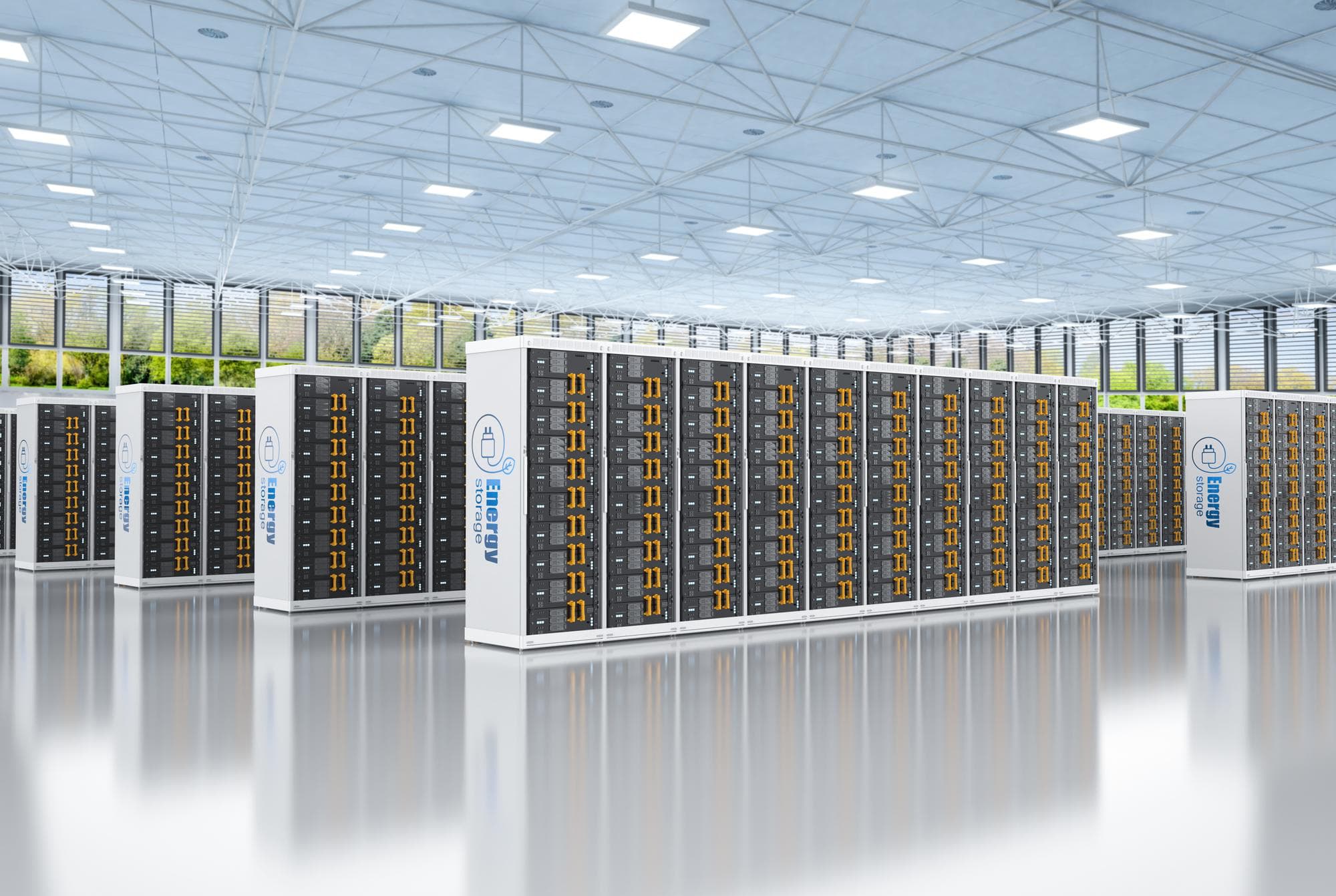
Battery energy storage is increasingly relevant to data center energy strategies because it can provide capabilities beyond traditional emergency backup.
Conventional uninterruptible power supply systems already use stored energy to maintain continuity during power disturbances and support the transition to backup generation. Larger battery energy storage systems can serve additional functions, depending on their design and integration with the campus electrical system.
One potential application is managing short-duration changes in power demand. Batteries can respond quickly to electrical commands, making them useful for supporting certain load-management and power-stabilization functions.
For a campus with on-site generation, battery storage may help coordinate the response to changes in computing demand. This can be particularly valuable when generation equipment operates most efficiently within particular operating ranges or cannot respond instantaneously to rapid load changes.
Storage can also support broader energy-management strategies, including peak-demand management, selected grid services, and coordination with variable renewable generation where those applications are technically and commercially appropriate.
The important distinction is that batteries complement other energy resources rather than universally replacing them. Their usefulness depends on power rating, energy duration, control architecture, operating strategy, and the specific requirements of the data center.
On-Site Generation Must Account for Workload Behavior
The growing interest in on-site generation introduces another reason to understand AI power demand.
A data center that incorporates gas turbines, reciprocating engines, fuel cells, or other generation technologies must consider how those resources will operate alongside the facility's electrical load. Different technologies have different operating characteristics, including minimum operating levels, ramping capabilities, efficiency profiles, and maintenance requirements.
These characteristics become relevant when computing demand changes over time. A generation system designed around a relatively stable load may require additional controls or complementary resources when supporting a more variable operating profile.
For example, a campus may use battery storage to help manage rapid changes in demand while dispatchable generation responds over a longer interval. In other configurations, utility power may provide the primary supply while on-site generation contributes additional capacity or resilience.
The appropriate solution depends on the campus's operational objectives, generation technology, electrical configuration, and utility relationship.
The broader principle is that generation should be designed around the actual operating requirements of the computing environment. Nameplate capacity establishes how much electricity a system can produce, but operating characteristics determine how effectively that capacity supports the load.
The Utility Relationship Is Becoming More Technical
As AI campuses become larger and more electrically sophisticated, utilities need greater visibility into their operating characteristics.
Historically, large-load planning has focused heavily on expected peak demand, annual electricity consumption, connection requirements, and future expansion. Those factors remain essential, but load variability and the speed of demand changes can also become relevant to system studies and operating arrangements.
A campus that introduces substantial demand into a particular area may require detailed evaluation of voltage performance, transmission and distribution capacity, protection coordination, and system stability. The importance of each consideration depends on the characteristics of the surrounding grid and the proposed facility.
Providing accurate information early can improve coordination between the utility and the data center developer. Expected demand, operating patterns, expansion schedules, and the potential role of on-site generation or storage can all help establish a more complete understanding of the project.
This creates an opportunity for closer technical collaboration. Instead of treating electricity delivery as a separate activity from computing operations, utilities and developers can increasingly coordinate around the electrical characteristics of the entire campus.
AI Can Also Improve Energy Management
Artificial intelligence is not only changing electricity demand. It can also support the technologies used to manage that demand.
Advanced analytics can help operators understand energy consumption across computing systems, cooling equipment, electrical distribution, and supporting infrastructure. By analyzing operational data, these systems can identify patterns that may be difficult to recognize through conventional monitoring alone.
Predictive models can support load forecasting, equipment performance analysis, and more informed energy-management decisions. They can also help operators anticipate changes in demand associated with scheduled computing activity or expected variations in facility operations.
The value of these capabilities depends on reliable data, appropriate controls, and human oversight. AI-based analysis does not replace electrical engineers, operators, or energy specialists. Instead, it can provide additional information that helps experienced teams make better decisions.
For large campuses, this combination of operational expertise and advanced analytics can support more coordinated management of increasingly complex energy systems.
Computing Schedules Can Become Part of Energy Strategy
Another important development is the potential relationship between computing schedules and electricity management.
Not every computing workload has identical timing requirements. Some applications require immediate responses and continuous availability, while other tasks may offer greater scheduling flexibility.
Certain AI training, batch-processing, and non-time-critical computing activities may be capable of operating within defined scheduling windows. Where technically feasible, this flexibility can create opportunities to coordinate selected computing activity with energy-system conditions.
For example, workloads that can tolerate delays may be scheduled around periods of greater electricity availability or more favorable operating conditions. In other cases, computing resources may be managed to reduce simultaneous peaks across large clusters.
These approaches require careful evaluation. Workload movement can involve performance, networking, data-locality, customer-service, and operational considerations. Critical computing activities cannot simply be interrupted whenever electricity conditions change.
Nevertheless, the ability to coordinate selected workloads with energy operations introduces an additional tool for sophisticated data center management.
The opportunity is not to make computing subordinate to electricity availability, but to identify where operational flexibility can improve the performance of both systems.
Energy Storage and Generation Can Work as One System
As data centers incorporate multiple energy resources, the interaction between those resources becomes increasingly important.
A campus may receive electricity from the utility, operate on-site generation, incorporate battery storage, and use advanced electrical controls to manage power distribution. Each component has distinct capabilities, but the overall performance depends on how they operate together.
An integrated energy-management system can coordinate these resources according to operating priorities. Those priorities may include reliability, power quality, equipment performance, energy efficiency, and compliance with utility requirements.
For example, batteries may provide fast-response capabilities while generation systems supply sustained electricity. Utility service may provide additional capacity and system support, while electrical controls manage transitions and operating conditions.
The objective is to create a coordinated energy architecture rather than a collection of independent technologies.
This becomes particularly valuable for large AI campuses, where electrical demand can be concentrated and operational requirements may evolve as computing capacity expands.
The Power System Must Evolve With the Campus
Large data center campuses are rarely completed at their ultimate capacity on the first day of operation. They typically develop in phases, with additional buildings, computing systems, and electrical infrastructure introduced over time.
The energy architecture therefore needs to support both initial operations and future expansion.
A campus may begin with a combination of utility capacity and conventional electrical distribution, then incorporate additional substations, generation, storage, or advanced controls as its computing requirements increase.
The challenge is ensuring that early infrastructure decisions remain compatible with future operating requirements. Electrical distribution, protection systems, generation controls, and energy-management platforms should be evaluated with the expected development roadmap in mind.
This is especially relevant for AI environments because computing technologies continue to evolve. Future hardware may introduce different power densities, conversion requirements, and operating characteristics from those associated with current deployments.
A well-planned energy system should provide the flexibility to accommodate those changes without requiring the entire architecture to be reconsidered whenever a new generation of computing equipment arrives.
From Megawatt Planning to Energy Performance
The expansion of AI infrastructure is encouraging a more complete definition of data center power strategy.
Capacity remains essential. Developers must secure sufficient electricity, establish credible delivery schedules, and build infrastructure capable of supporting future demand.
However, capacity alone does not describe the performance of an electrical system. The ability to manage load changes, maintain power quality, coordinate generation, integrate storage, and support high-density computing is also important.
This creates a distinction between having access to electricity and designing an energy system that can use that electricity effectively.
For data center developers and energy specialists, the opportunity is to bring these considerations together earlier in the planning process. Understanding computing requirements can inform electrical architecture, while understanding energy-system capabilities can support more effective campus design.
The result is a closer relationship between the power strategy and the computing strategy.
Designing Power Around Computing
The Future of Data Center Energy Is More Integrated
Artificial intelligence is changing how data centers use electricity, and that evolution is creating new opportunities for energy-system design.
Higher computing densities, concentrated GPU workloads, changing utilization patterns, and more sophisticated operating requirements are encouraging developers to think beyond total megawatt capacity. Electrical distribution, power quality, generation performance, battery storage, and intelligent energy management are becoming increasingly interconnected considerations.
These developments do not reduce the importance of securing sufficient electricity. Instead, they expand the definition of what an effective power strategy needs to accomplish.
The most successful approaches will account for both the quantity of electricity required and the characteristics of the computing systems that consume it. Utilities, developers, engineers, and operators can then coordinate generation, delivery, distribution, and management around a more complete understanding of campus operations.
As AI infrastructure continues to evolve, the relationship between computing and energy will become increasingly important. The opportunity is to design power systems that do more than support larger data centers. They can support more capable, adaptable, and efficient computing environments throughout the full lifecycle of the campus.